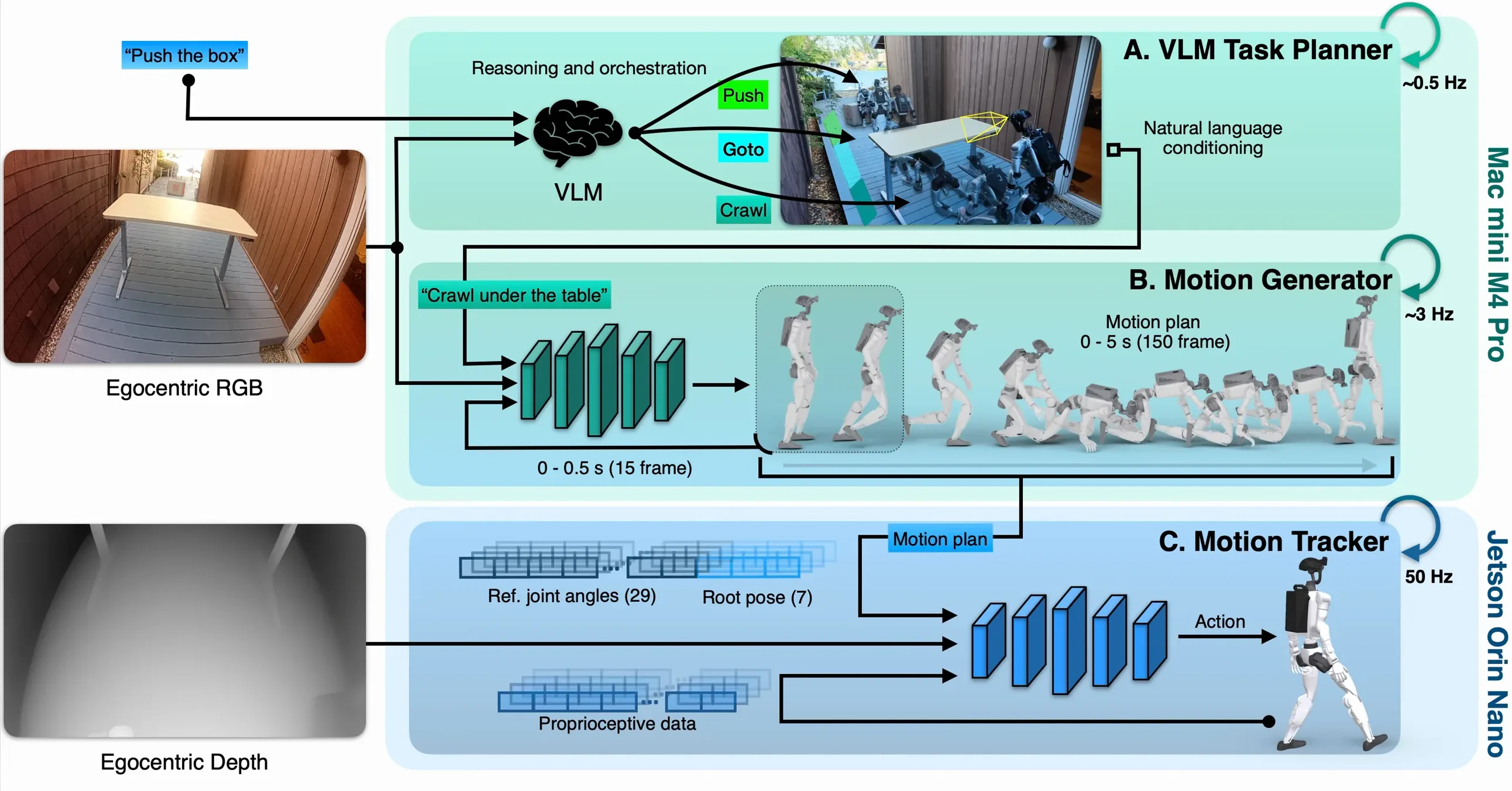
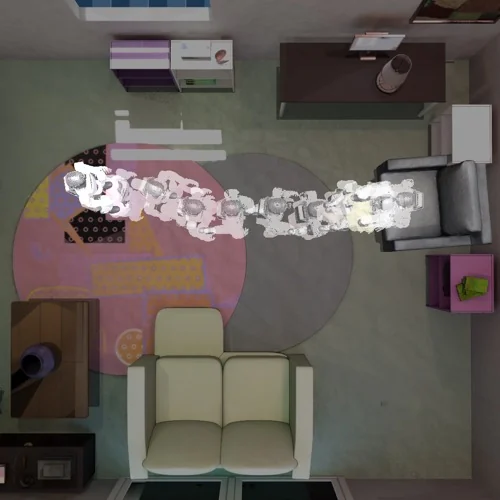
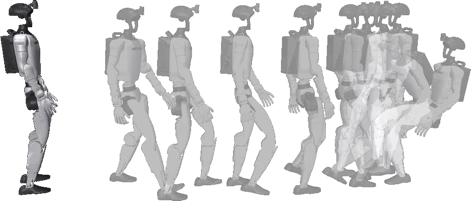
Animated timeline of the onboard stack; time flows right to left past the present. About every 2 s the orchestrator picks the next subtask; every third of a second the generator replans 5 s of whole-body motion, 150 frames of 36 values, whose first 0.5 s is committed; the tracker follows it at 50 Hz.
RGB · 120°
Spoken requests, one after another: “Push box away”, “Follow me”, “Sit inside”.“Push box away”
Depth · 55°
Orchestrator, off-the-shelf VLM, about every 2 s, on the backpack compute unit: turns the operator's requests into subtasks (crouch under the table, push the box, follow the person, go through the door, go to the chair, sit); advances on success, retries on failure. The requests and subtasks are the run's own log, aligned to the video.
Generator, about 3 Hz, on the backpack compute unit: from the RGB image and the current subtask, a 5 s whole-body plan, 150 frames of 36 values; frozen Qwen3.5-2B encoder with a DiT decoder, flow matching, 15 Euler steps. The first 0.5 s (15 frames) is committed and fed back as clean tokens.
Tracker, 50 Hz, on the embedded compute unit: follows the plan with onboard depth and proprioception and outputs joint targets for 29 joints.
Real-time chunking
84%Sit taskSit task success: 84%
Executed
Plan
Committed
Gallery
Siton a chair
Doorsidestep through
Crouchunder a table
Pusha box
Crouchunder a desk
Crouchunder a desk
Followa person
Siton a sofa
Crawlunder a desk
Go-Toa person
Go-Toa person
Crawlunder a table
Doorsidestep through
Followafter standing up
Crouchunder a table
Crouchunder a desk
Siton a chair
Crouchunder a desk
Pusha box
Doorsidestep through
Go-Tothe trash bin
Crawloutdoors
Pusha box
Crawlunder a table
Siton a chair
Siton a sofa
Go-Toa person
Crawlunder a desk
Pusha box
Doorsidestep through
Simulation Results
Drag or use the arrow keys to orbit. Plus and minus zoom. Home resets the camera.
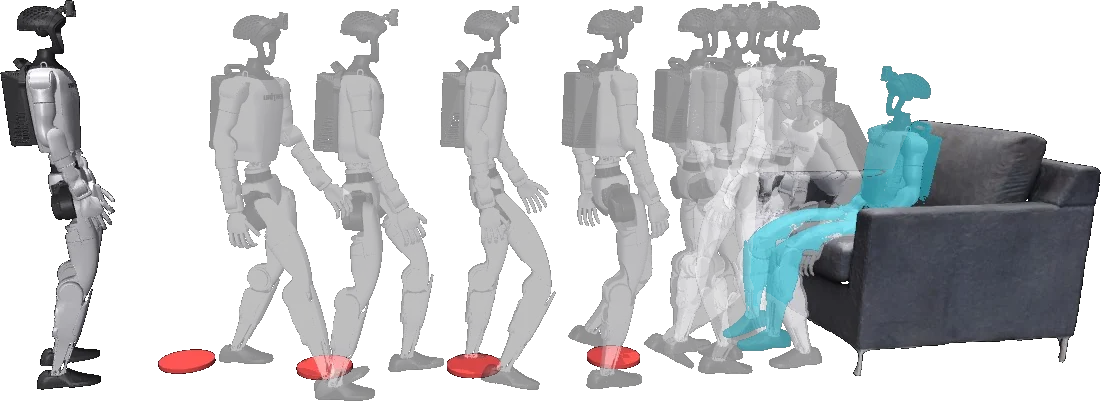
A, Kinematic motion generation: the task “sit on the armchair” splits into walk forward, turn around and sit on chair; Kimodo generates each segment from a text prompt, optional waypoints and a terminal keyframe; 33 geometric checks keep the best of N candidates.
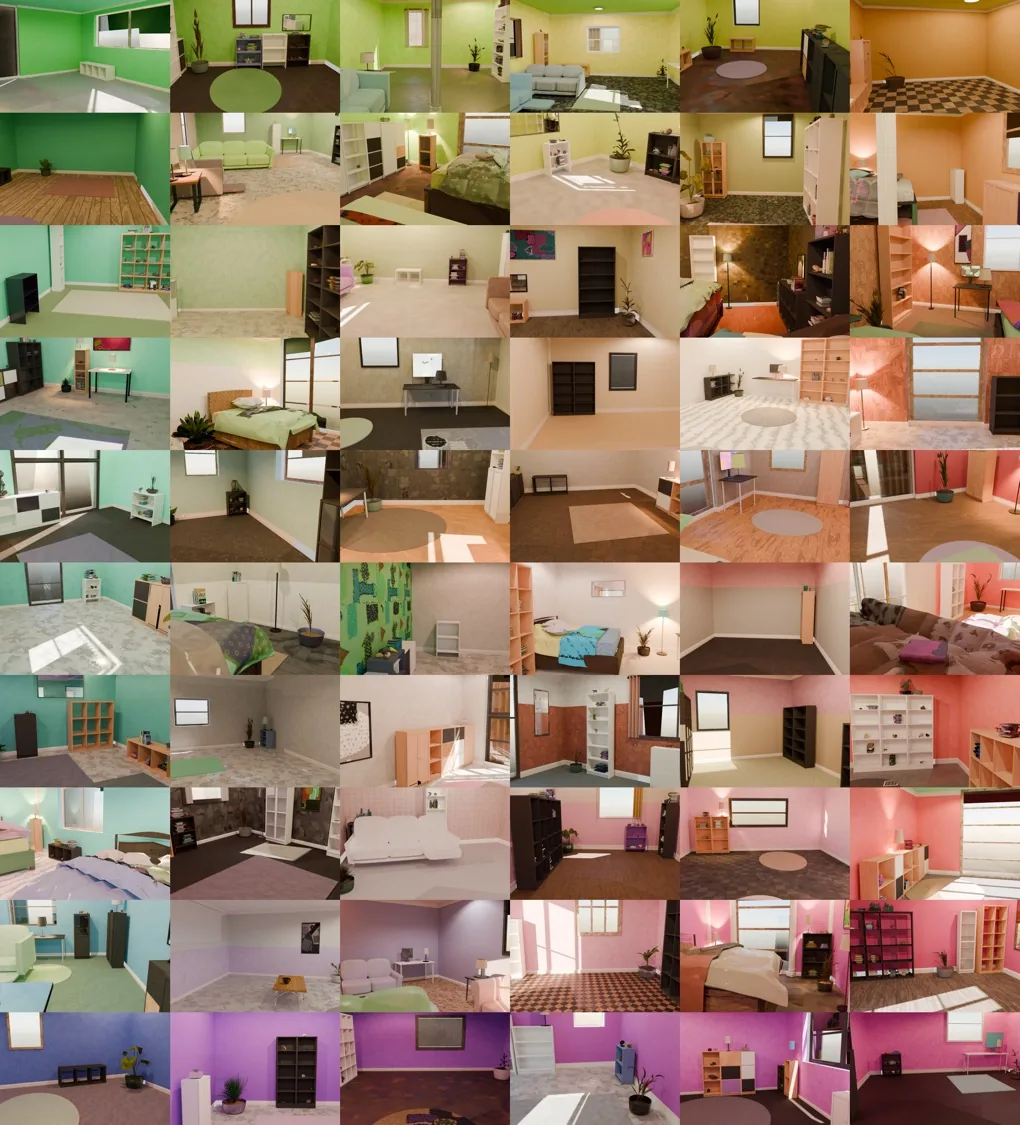
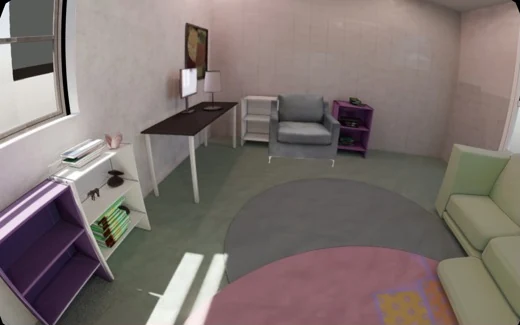
B, Scenario staging: Infinigen generates 1,000 homes; the motion is placed by sampling SE(2) poses and keeping the first collision-free one. An episode is a seed plus a placement record.
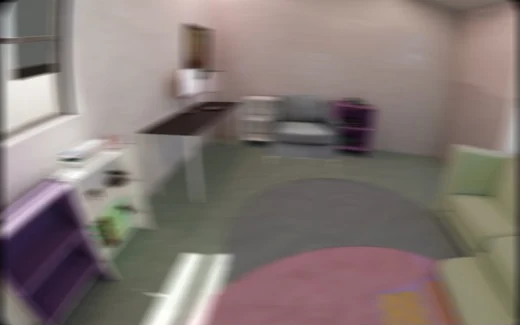
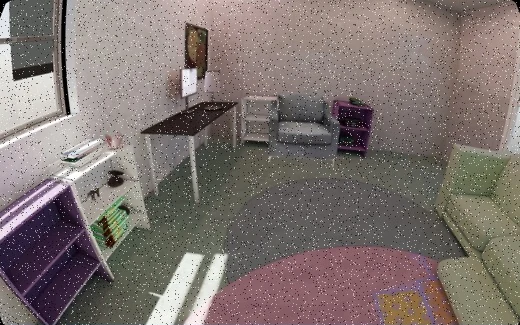
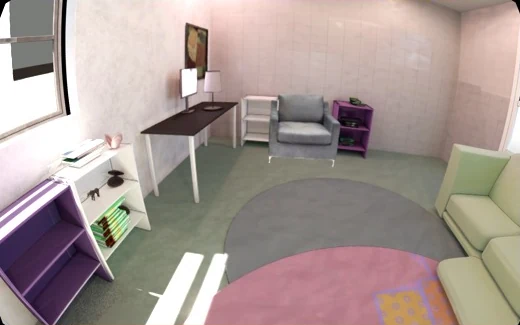
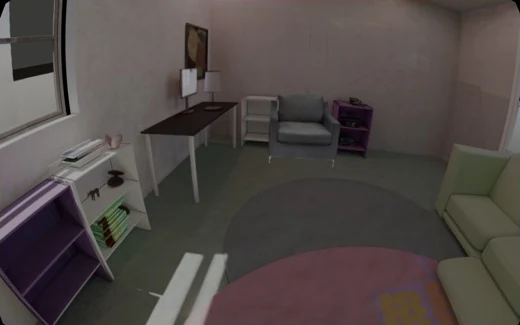
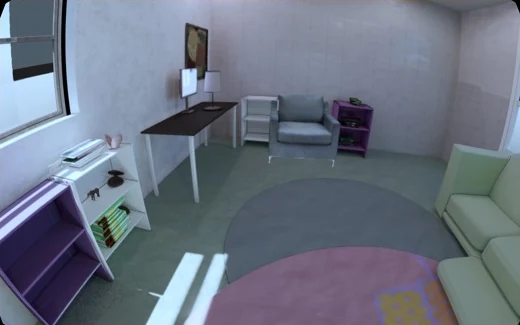
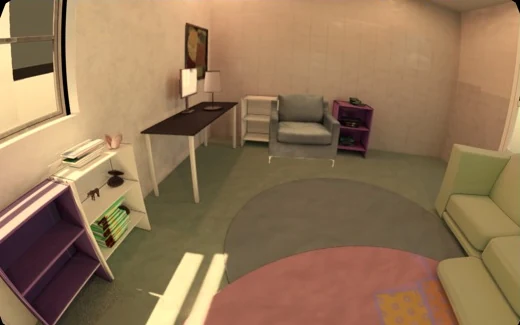
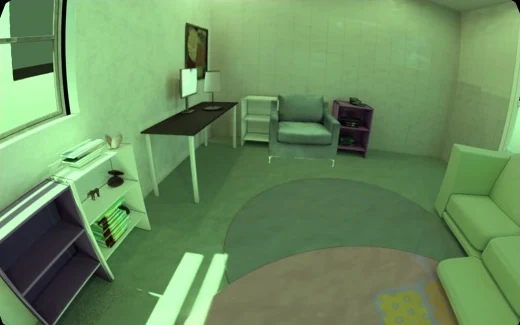
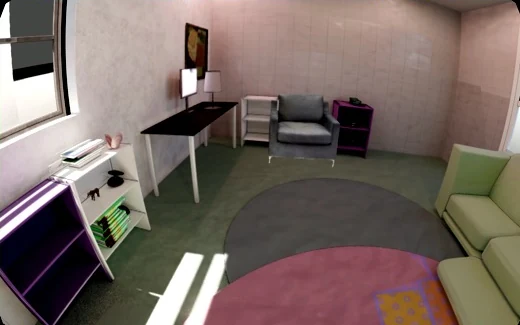
C, Egocentric camera rendering: a hardware-matched fisheye camera; the original render and eight visual randomizations: motion blur, salt and pepper, bright light, low light, cool tone, warm tone, green tint, high contrast.
D, Training motion generator and tracker with synthetic data: paired video, language and motion from 1,000 homes; imitation learning trains the motion generator on 64 B200, reinforcement learning the motion tracker on 4 H100. The corpus is generated on 250 H100.
Hardware System
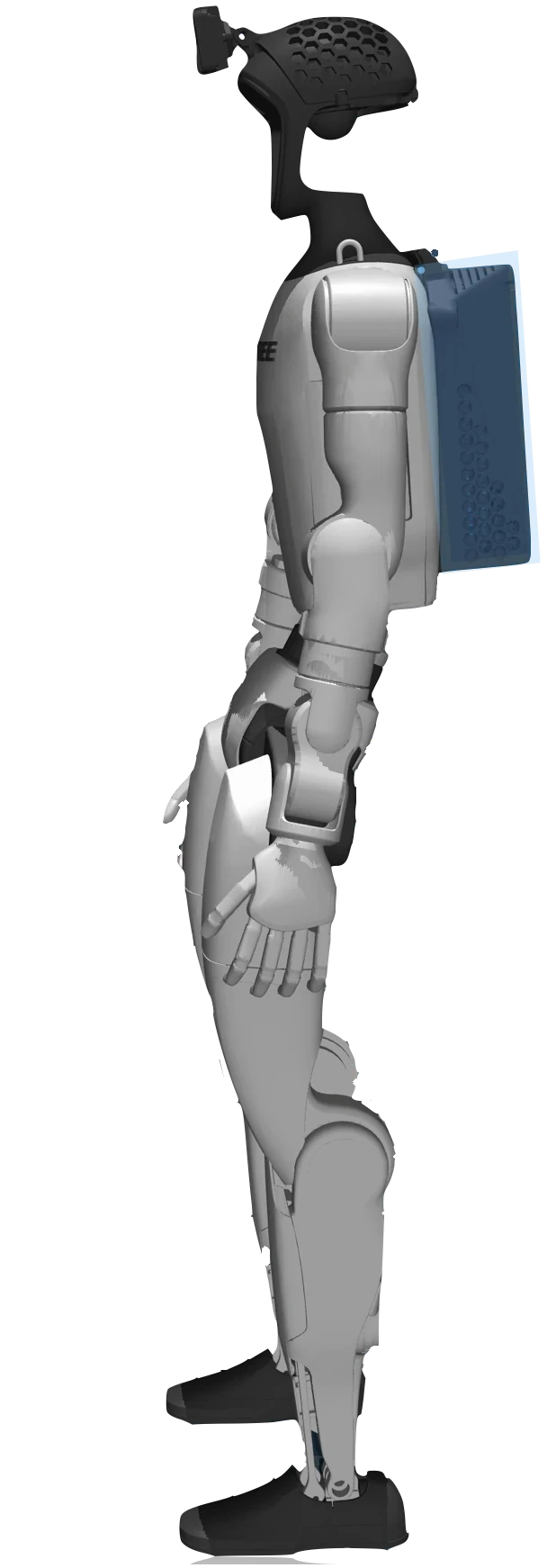
29-DoF Joint Actuators
Video
0:000:00
Cite
BibTeX
@article{halo2026,
  title     = {Perceptive Humanoid Motion from Simulation},
  author    = {Hu, Siyuan and Abuduweili, Abulikemu and Meng, Yue and Liu, Shipeng and Leboutet, Quentin and
               Chen, Chen and M{\"u}ller, Matthias and Koltun, Vladlen},
  journal   = {arXiv preprint arXiv:2611.06908},
  url       = {https://arxiv.org/abs/2611.06908},
  year      = {2026}
}